



What Manufacturing Teams Actually Need From a Learning Platform
Table of Contents
Table of Contents
Last updated: November 23rd, 2026
Manufacturing teams need a learning platform that reaches workers on the floor, not just at desks: mobile-first training that works on any device, even offline; automated compliance and certification tracking; training content that updates as fast as work instructions change; and one system that also trains the dealers, distributors, and customers who touch the product.
Most platforms on a “best LMS for manufacturing” shortlist weren’t built for any of that. They were built for people with desks, laptops, and inboxes — which describes almost nobody on a plant floor. Litmos is the Learning Acceleration Platform, built for teams who’ve outgrown the traditional LMS: one platform that builds, activates, and evolves capability across your workforce, partners, and customers, in the flow of work.
Here’s what separates a platform that works in manufacturing from one that just demos well.
Why Is Training Harder in Manufacturing Than in Other Industries?
Training is harder in manufacturing because the standard corporate playbook assumes things a plant doesn’t have: workers at desks, one shared schedule, and processes that hold still long enough to train on.
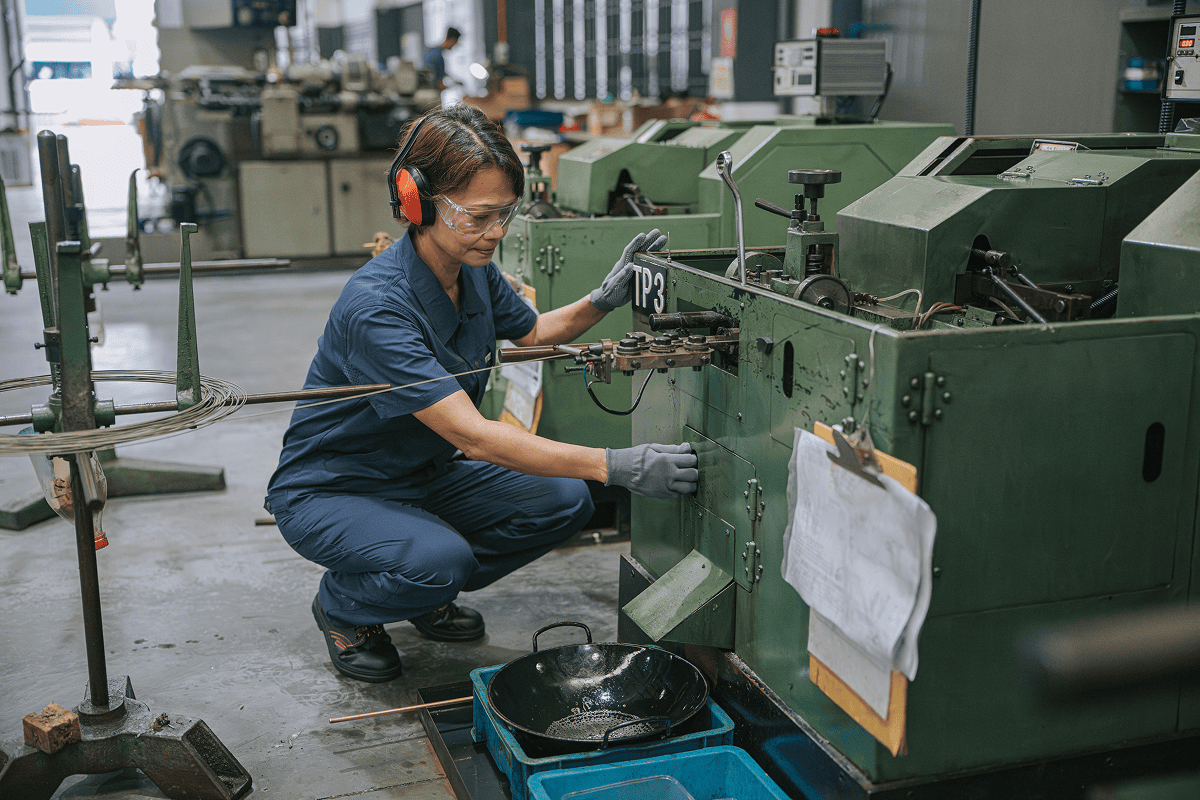
Start with the workforce itself. Operators, technicians, and line leads don’t work in front of computers, and most never sit at a desk. Every hour of classroom training is an hour off the line, so training competes with production, and production usually wins.
Then there’s the clock. A three-shift operation never has everyone in the building at once. One live session reaches a third of the plant; everyone else gets the summary secondhand.
Meanwhile, the work keeps changing. New equipment arrives, engineering changes land, work instructions get revised, and the training binder is out of date before the laminator cools.
The deepest expertise is also walking out the door. The 2024 Deloitte and The Manufacturing Institute Talent Study projects a need for as many as 3.8 million new US manufacturing employees between 2024 and 2033, with about 2.8 million of those openings coming from retirements. About half of the 3.8 million (1.9 million jobs) could go unfilled if the skills and applicant gaps aren’t addressed. Every retirement takes decades of process knowledge with it, and much of that knowledge was never written down.
The industry has called this a skills gap for years. A gap implies something you close once. What’s actually happening is erosion: skills decaying faster than traditional programs can retrain. We call it the Capability Erosion Crisis (the growing breakdown between the pace of change and a business’s ability to adapt to it), and few industries feel it more directly than manufacturing.
And over all of it sits the audit. In plants running under ISO certifications, OSHA requirements, or FDA oversight, training isn’t done until it’s documented. When an auditor asks who was trained on which revision of a procedure, “most people” is the wrong answer.
What Should the Best LMS for Manufacturing Include?
The best LMS for manufacturing is built around six requirements that office-first platforms treat as afterthoughts:
- Mobile training that works on the floor. Operators need training on a phone or a shared tablet at the line, not a desktop in a training room. Look for a mobile-first platform with offline access and short, role-based lessons a supervisor can assign at shift start, not hour-long courses that pull people off the line.
- Compliance and certification automation. Safety and quality training runs on cycles: initial certification, recertification, retraining after an incident or a procedure change. The platform should assign training by role and site, track expiration dates, and trigger recertification automatically, so nothing depends on a spreadsheet someone remembers to check.
- Audit-ready records. When an auditor asks who completed which training on which version of a procedure, the answer should be a report you pull in minutes, not a week of reconstruction.
- Content that updates as fast as the work. A revised work instruction should become updated training the same week, not next quarter. AI authoring helps here: AI drafts the course and refreshes existing modules when procedures change; your team reviews and publishes.
- Multilingual delivery. Many plants run in more than one language. If training exists only in English, you’re training some of your people and hoping the rest absorb it secondhand.
- One platform for every audience you train. Manufacturers rarely train employees alone. Dealers, distributors, service technicians, and customers all need to install, operate, and maintain the product correctly. This matters enough to get its own section below.
Integrations belong on the list too, quietly: when the platform pulls roles, sites, and start dates from your HR system, assignments follow people automatically as they’re hired, promoted, or moved between lines.
Training the Old Way vs. What Manufacturing Teams Need
Use this as the shortlist test. Every habit on the left is a sign a platform was designed for a different kind of company.
|
The old way |
What manufacturing teams need |
|
Classroom sessions scheduled around production |
Short lessons delivered at the line, on any shift |
|
Binders, posters, and undocumented know-how |
Versioned digital training tied to the current work instruction |
|
The annual compliance course everyone speed-clicks |
Role-based certifications with automatic recertification |
|
Training records in spreadsheets |
Audit-ready reports on demand |
|
English-only content |
Training in every language the plant speaks |
|
Employees only |
One platform for your workforce, partners, and customers |
|
Months of implementation before anyone learns anything |
A platform that’s live in days, not months |
Why Should a Manufacturing LMS Train More Than Employees?
Because many of the people who determine whether your product succeeds don’t work for you. Dealers sell it, distributors stock it, service technicians repair it, and customers operate it every day — and all of them perform based on what they know.
When that knowledge is thin, you feel it as warranty claims, support tickets, misused equipment, and a channel that sells whatever it understands best. When it’s strong, partners represent the product consistently across markets, and customers get value faster, which is what keeps them renewing, reordering, and recommending. For some manufacturers, customer education even becomes a product of its own: a paid certification program or product academy.
Most learning platforms bolt these audiences on: a separate portal, a separate contract, a separate admin burden. In practice, that means partner and customer training either doesn’t happen or lives in a second system nobody maintains. A platform built for extended enterprise training runs all three audiences from one place, with a distinct experience for each: your workforce, your partners, and your customers.
How Litmos Supports Manufacturing Teams
Litmos is built for the problems this article describes: one platform that builds, activates, and evolves capability across your workforce, partners, and customers, at the speed the work changes.
➡️ Read our case study to learn how Russell Mineral Equipment maintains a 99% compliance rate on Litmos, with 120+ proprietary courses its own teams built.
On the floor, that means short, role-based training learners take on mobile, in the flow of work. It’s available in 37 languages, with offline access for the parts of the plant where connectivity drops. Supervisors assign it at shift start, and reminders reach learners as push notifications in the mobile app, not an inbox.
For compliance teams, Litmos automates certification cycles: training assigned by role and site, expirations tracked, recertification triggered automatically, and records ready before the auditor asks. See how Litmos approaches compliance and risk reduction.
For the people who build training, Litmos AI drafts course outlines, module content, and assessments. It refreshes existing modules as procedures, products, and regulations change, and your team reviews and publishes. The content you’ve already invested in comes with you: Litmos imports SCORM, xAPI, video, PDF, and PowerPoint files. That’s how training keeps pace with every revised work instruction instead of trailing a quarter behind.
Litmos also runs partner and customer training on the same platform, so your dealers, distributors, and customers learn from the same source of truth as your employees. Explore customer education.
More than 11,000 organizations in 150 countries use Litmos to accelerate performance, revenue, and compliance. And because the platform goes live in days, not months, manufacturing teams see value from Day 1.
See Litmos in action by requesting a demo today.
Frequently Asked Questions
What is the best LMS for manufacturing?
The best LMS for manufacturing reaches deskless workers on mobile, automates compliance certifications and audit-ready records, keeps training current as work instructions change, and trains dealers, distributors, and customers alongside employees. Litmos is the Learning Acceleration Platform, built for manufacturing teams who’ve outgrown the traditional LMS.
How do you train manufacturing employees who don’t have computers or company email?
Manufacturing teams train deskless employees by delivering short, role-based lessons on phones and shared tablets, assigned by supervisors and completed in minutes between tasks, with offline access where connectivity is unreliable. Assignments and reminders run through the mobile app and the supervisor, not an inbox. The requirement is a platform designed for frontline access, not one that assumes every learner has a desk and a desktop.
How does a learning platform help with manufacturing compliance training?
A learning platform built for compliance assigns training by role and site, tracks certifications and expiration dates, triggers recertification automatically, and produces exportable training records. Litmos automates certification cycles so that records are current and ready when an audit comes, instead of reconstructed from spreadsheets afterward.
Can an LMS train dealers, distributors, and customers as well as employees?
Yes. Platforms built for extended enterprise training run employee, partner, and customer programs from one system, with a distinct experience for each audience. Litmos trains all three — workforce, partners, and customers — on one platform, which keeps product knowledge consistent from the factory floor to the customer site.
How long does it take to launch a learning platform at a manufacturer?
Traditional enterprise LMS implementations can take months of configuration before anyone takes a course. Litmos customers go live in days, not months, so manufacturing teams see value from Day 1 instead of waiting out a long deployment.