


The Case for Learning Acceleration in 2026
A Three-Part Benchmark Report
Your Workforce’s Skills Are Decaying Faster Than You Can Rebuild Them
The Capability Erosion Crisis defines capability erosion as the business risk facing competitive organizations today and benchmarks where learning investment is going — revealing how organizations are responding as skills become obsolete faster than ever.
The capabilities you’re training for are already obsolete. That’s because AI isn’t just changing the work — it’s destroying the skills you need to do it. The half-life of skills has shrunk by 75% over the last decade. Your L&D team can’t keep up, and neither can any leader in customer education, enablement, operations, or change management. But winning organizations are building differently — faster, at scale, in real time. The data shows who’s adapting and who’s already falling behind.

The Uncomfortable Truth.
The Numbers Don’t Lie.
Companies are burning learning budgets defending compliance while capability building starves. The data bears this out, with 61% of top course assignments defending compliance, risk, and regulatory exposure – often at the expense of building human capabilities in future-ready skills. As the pace of change accelerates, this trade-off compounds a costly crisis: one where the skills needed for the future are left unfunded and workforces remain unprepared to face the challenges of the AI era.
shorter skills half-life over the past decade
of top course assignments focus on compliance, risk and regulatory exposure
of training investment goes toward building future-ready human capabilities

Inside the Report Series
Get instant access to the series as new parts are released.
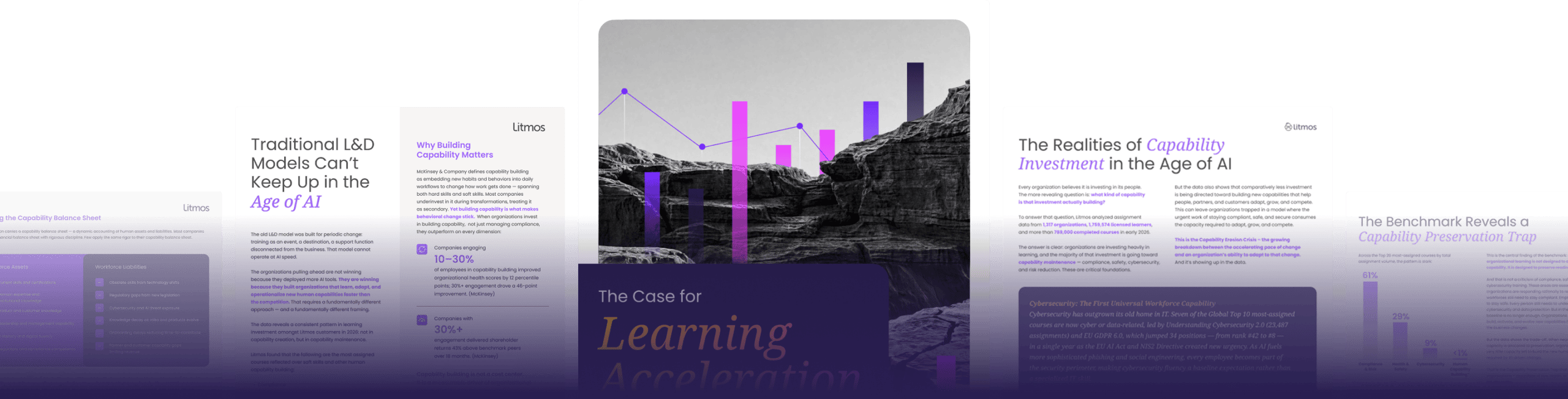
01The Capability Erosion Crisis
Why AI is a human issue, not just a technology issue, and how eroding human capability has become a defining business risk. See why capability building now needs to be mission-critical on the executive agenda.
 02
02Benchmarking Capability Erosion
What nearly 2 million learners reveal about where capability investment goes — including regional heat maps, version-history data, and learning capacity dedicated to compliance, safety, and cybersecurity.
The Learning Acceleration Advantage
How leaders are responding. Learn the Learning Acceleration Maturity Model and the five principles driving outcomes for organizations like TTEC, Graco, Headspace, Sabre, and more.

View
the Report
See why the Capability Erosion Crisis can’t be ignored and how companies build human capabilities to win in the age of AI.