


Should You Build or Buy Training Content? A Decision Framework for Business Leaders
Table of Contents
Table of Contents

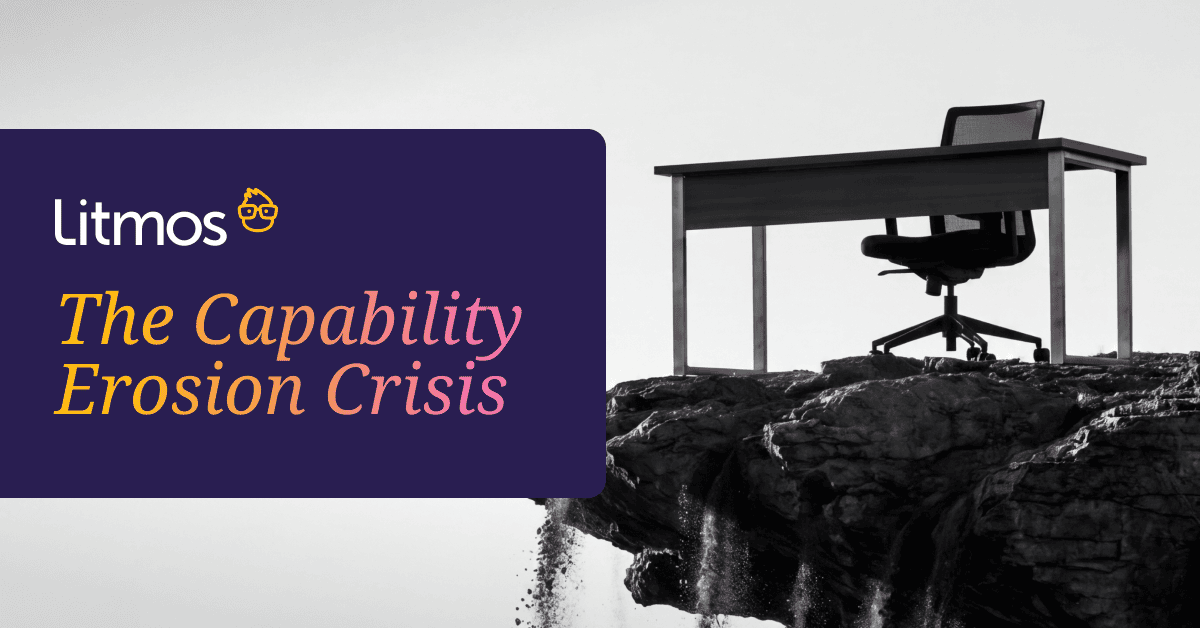
In age of AI, capabilities are expiring faster than ever. New roles, new regulations, new product launches, new initiatives — demand for capability building now outpaces what any internal team can produce on its own. : the gap between the speed your business is changing and the speed your people can keep up. Closing it requires Learning Acceleration.
The question is: how can organizations who are barely keeping up, close the gap to succeed in the age of AI?
It might be tempting to reach for the obvious lever: produce more. A new course, microlearning asset, or job aid for every disruptive shift that requires a new skill. Many organizations that opt for this approach make it exponentially harder on themselves by attempting to build everything in-house. Increasingly, the in-house content is generated with AI for maximum speed.
But the instinct to simply produce more, faster, is often a recipe for failure. The teams that move fastest aren’t out-producing competitors. They’re out-strategizing them. And the strategy that works requires a thoughtful response to these two questions:
- “Where does our team’s expertise create real, differentiated value?”
- “Where are we rebuilding something that has already been built, validated, and maintained by experts?”
These questions mark the beginning of the build-vs-buy decision-making process that, when done strategically can help teams close the Capability Erosion Gap through Learning Acceleration.
While most teams are making the build vs. buy decision implicitly (one overloaded subject-matter-expert request at a time) others are using a strategic framework to make the decision a deliberate one that maximizes performance at scale.
Take a free quiz to see which content strategy works best for your team: building content in-house, sourcing from experts, or combining approaches. Take the quiz →
Build What Only You Can Build (Source the Rest)
Your L&D team’s job is to be content strategists, not content factories. No matter your industry, company size, or learning audience, you know that there is certain content only you can create. From onboarding flows to product knowledge aids, to internal process documentation, your institutional know-how is your competitive edge; it’s the content that can’t be replicated or imitated by competitors. That’s why it’s important to protect the time it takes you or your team to build it well.
Almost everything else — compliance, soft skills, foundational technical and safety training — already exists, if you know where to find it. If you’re looking for professionally developed, well-researched, validated, and up-to-date content, built and maintained by experts, sourcing it isn’t a compromise, but a necessity for freeing bandwidth for your team to focus on tasks that move the business forward.
So where does AI fit into this equation? AI-assisted authoring is excellent for accelerating the content only you can build. However, it’s a poor substitute for buying the kind of up-to-date, SME-authored pre-built content we described above. Generating volume to fill a thin library can produce more content, sure. But not necessarily the right content. And in regulated areas like compliance, safety, and finance, “more” without expert review can open your business to liability and risk exposure. Trusted content from internal, external, and third-party sources is what keeps capability building verified, governed, and relevant.
Four signs you’re building what you should be buying
- Rollouts slip. A compliance deadline or product launch needs training on day one — and the course is still in review.
- Your SMEs are the bottleneck. Every new requirement lands on the same sales leader, compliance officer, or product manager who was never meant to be a content factory.
- Learners get inconsistent versions. Some teams are on current material; others are running content that hasn’t been touched in two years.
- Compliance exposure grows quietly. Out-of-date regulatory content isn’t just an L&D problem — it’s legal and financial risk. The Ponemon Institute pegs the cost of non-compliance at an average of $14.8M a year, roughly three times the cost of staying current.
If those sound familiar, the issue isn’t effort. It’s that your team is spending finite capacity building things that don’t differentiate you.
What it Looks Like When the Decision is Made Well
When content stops being the constraint, strategy finally ships. A few examples from teams that got the build-vs-buy balance right:
Air General – The freight and logistics company customizes its own internal courses while drawing on the prebuilt Litmos library for everything else. It has grown from 11 employees and 2 courses in 2015 to 700+ employees trained across 37 sites today — with audit-ready reporting for TSA-mandated compliance. Read their story →
LaborMAX Staffing – The staffing firm went from no formal training program to a thriving learning culture, saving $192K on onboarding and training new employees, with nearly 40,000 courses taken across 865 learners. Read their story →
The pattern is consistent. These teams didn’t scale by building more. They scaled by making a strategic series of decisions about what to build and what to buy.
Uncover Your Content Decision Strategy
Most teams already sense they’re rebuilding too much. The harder part is knowing exactly which categories to keep in-house and which to source — and the answer is different for every team, depending on your risk profile, your SME capacity, and where your real differentiation lives.
That’s exactly what our Build vs. Buy decision tree is built to surface. In about two minutes, it walks you through the questions that matter and gives you a clear, defensible recommendation you can take to your team.
Your strategy may not need more content. It may just need a clearer line between what to build and what to buy. Take the Build vs. Buy quiz →