


The Capability Erosion Crisis: Why Your AI Strategy Is Missing Its Most Important Ingredient
Table of Contents
Table of Contents

What is the Capability Erosion Crisis?
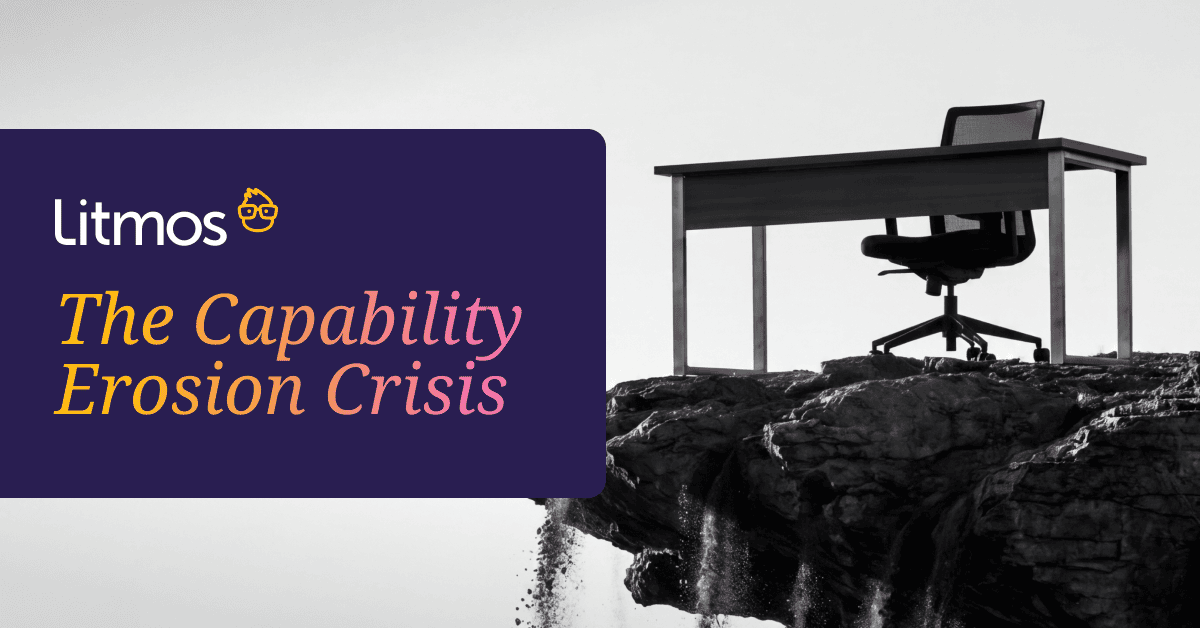
There’s a crisis quietly compounding inside most organizations right now — and it has nothing to do with technology.
Companies are racing to deploy AI tools, agents, and automation at unprecedented speed. But here’s what the winners already understand: the bottleneck isn’t the technology. It’s people. Specifically, it’s the growing breakdown between the accelerating pace of change and an organization’s ability to continuously build, activate, and evolve new human capabilities to match it.
This is what we at Litmos are calling the Capability Erosion Crisis.
The Numbers Are Stark
The evidence is everywhere. Skills are expiring faster than ever, and the numbers show that executives and workers face an uphill battle to refresh or replace critical workforce skills as their shelf-life continues to decrease:
-
- 59% of workers will require retraining as AI reshapes job functions
-
- 74% of companies report they can’t keep up with rising demand for new capabilities
-
- 63% of CEOs say skills availability is their single biggest growth barrier
This concerning trend isn’t just noticable to internal functions of an organzation. 31% of customers cancel due to poor onboarding and training. 61% of new products fail because customers don’t understand them well enough to use them. AI compresses time. It doesn’t just create demand for new capabilities — it eats the old ones, shrinking the window organizations (and their customers, partners, and vendors) have to adapt. Capability deficiencies compound silently, reducing performance and eroding competitive position before most leadership teams have a name for what’s happening.
This Isn’t a Training Problem
The old L&D model was built for periodic change: training as an event, a destination, a support function disconnected from the business. That model can’t operate at AI speed. The organizations pulling ahead aren’t winning because they deployed more AI tools. They’re winning because they built organizations that learn, adapt, and operationalize new human capabilities faster than the competition. That requires a fundamentally different approach — and a fundamentally different framing.
The new imperative isn’t training. It’s Learning Acceleration.
What Learning Acceleration Looks Like
Learning Acceleration is the ability to continuously build and evolve human capabilities across your workforce, partners, and customers at the speed your business demands. It means your workforce can absorb new capabilities as fast as AI reinvents their roles. It means your partners stay current. It means customers achieve real adoption from day one. Each is a distinct challenge. Together, they represent both the full scope of the Capability Erosion Crisis — and the full opportunity for organizations that solve it.
Capability erosion isn’t slowing down. Neither should you.
When 63% of CEOs say skills availability is their biggest growth barrier, this is a board conversation. When 31% of customers churn because they can’t succeed with your product, this is a revenue conversation. When your workforce can’t keep pace with your AI strategy, this is a competitive survival conversation.
Organizations that reframe this moment — from “we need better training” to “we need Learning Acceleration” — will be the ones that build, adapt, and win in the AI era. The ones that don’t will keep deploying AI tools into organizations that aren’t ready to use them.
This isn’t a one-off observation. It’s a trend that shows up in the data from our in-house, three-part benchmark report, The Case for Learning Acceleration in 2026. Built on data from 1,317 organizations and 1.76 million learners, this report series quantifies how fast skills are decaying, where learning investment is actually going, and what separates the organizations pulling ahead from the ones falling behind.
If this article raised the alarm, the report shows you the evidence — and the path forward.
Sources:
- CIO Magazine, The incredible shrinking shelf life of IT skills, November, 2025.
- McKinsey & Company, How European organizations can treat skills as a strategic priority, April 2026.
- World Economic Forum, Future of Jobs Report 2025, January, 2025.
- Josh Bersin, New Research: How AI Transforms $400 Billion Of Corporate Learning, February 2026.
- Customer Success Industry Statistics worldmetrics.org
- Kantar Worldpanel, How to ensure your innovation doesn’t fail after launch, Kantar, October 2022.