
What is the 70/20/10 Model? Advantages, Disadvantages, and How to Use it in Your Corporate Learning Program
Key Takeaways:
|
In many organizations, workplace learning has traditionally meant formal training programs such as classroom sessions, eLearning modules, and workshops. While these experiences have value, they only represent a fraction of how people truly develop skills and knowledge on the job. The 70/20/10 learning model offers a more holistic perspective, helping L&D professionals design initiatives that leverage the full spectrum of workplace learning opportunities.
What is the 70/20/10 Model?
The 70/20/10 framework originated from research conducted by Morgan McCall, Michael Lombardo, and Robert Eichinger at the Center for Creative Leadership in the 1980s. Through interviews with successful executives, they found that people tend to learn:
-
-
- 70% from on-the-job experiences, tasks, and problem-solving
- 20% from interactions with others, such as coaching, mentoring, and feedback
- 10% from formal learning, such as courses and structured training
Although these percentages are not meant to be prescriptive, they underscore the idea that the majority of employee development happens outside the traditional classroom or formal training space. For L&D professionals, this shift transforms their role from content creators to architects of learning ecosystems that integrate experience, social learning, and structured training.
What are the Advantages of the 70/20/10 Model?
The 70/20/10 learning model positions workplace learning as continuous, contextual, and embedded in day-to-day work. Corporate training and employee development programs built on this model help learners obtain relevant skills while actively tackling challenges, collaborating with colleagues, and reflecting on outcomes.
A well-designed learning strategy aligned to 70/20/10 ensures that formal training is reinforced with real-world application and peer-based learning.
What are the Disadvantages of the 70/20/10 Model?
-
-
- Lack of Formal Training: One of the biggest challenges with the 70/20/10 framework is that the majority of learning, particularly the 70% gained through on-the-job experiences and the 20% from social interactions, happens outside traditional, trackable training environments.
- Less Measurable Learning Data: Unlike formal courses, which have clear attendance records, assessments, and completion data, experiential and social learning are more fluid and less visible.
- More Anecdotal Learning Data: Measuring their impact often requires indirect methods such as manager feedback, self-reflection journals, project outcomes, or performance reviews.
- Less Traceability: Even when feedback and assessments are available to measure learning outcomes, it can be difficult to isolate which skill improvements came directly from which type of learning (on-the-job, informal, or formal)
-
For L&D professionals, this means moving beyond course completion metrics and adopting broader evaluation strategies that capture behavior change, collaboration patterns, and real-world application of knowledge over time.
Examples of 70/20/10 in Workplace Learning Environments
Instead of thinking of the model as a strict ratio, L&D professionals should see it as a guide for balancing different learning opportunities. For example, a new project manager may:
-
-
- Attend a formal leadership course (10%)
- Receive regular coaching from a senior leader (20%)
- Take on a high-visibility project managing a cross-functional team (70%).
-
Each component reinforces the others, creating a richer and more durable learning experience.
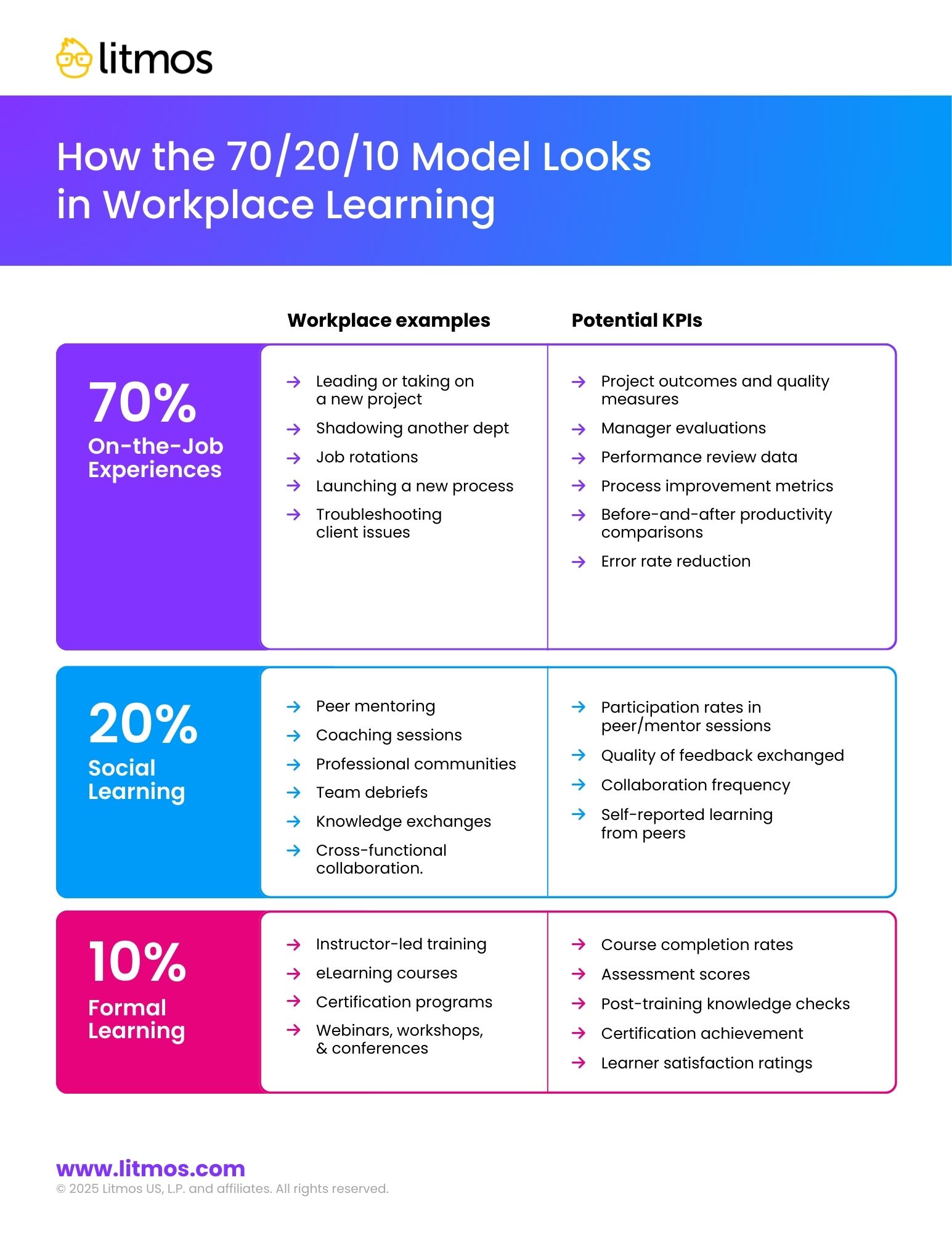
The image below outlines workplaces examples of the 70/20/10. If you’d like to have your own copy of this cheatsheet, you can download it by clicking the link or image below.

How to Apply the 70/20/10 Model to Your Learning Workflows
Applying the 70/20/10 model isn’t about abandoning formal training; it’s about extending learning beyond the classroom so that employees use and deepen what they’ve learned in authentic contexts. Here are four tips for integrating 70/20/10 into your workplace strategy:
-
-
- Designing for Application. Too often, training stops at knowledge transfer. The 70% portion of the model reminds us that application is where the real development happens. This means structuring post-training assignments, projects, or challenges that require learners to use their new skills immediately. For example, after a negotiation skills workshop, participants could be assigned to lead a real negotiation with support from a mentor who can provide feedback afterward.
- Encouraging Peer and Mentor Interaction. The 20% component thrives in environments where feedback and knowledge sharing are valued. L&D can facilitate this by creating peer learning groups, communities of practice, or mentorship programs. When learners share experiences and advice, they not only reinforce their knowledge but also create a culture where learning is an ongoing, shared responsibility.
- Making Formal Learning a Launchpad. The 10% should not be isolated events; they should act as a catalyst for the other 90%. This might involve building learning pathways where a course is followed by peer coaching or integrating case studies from the workplace into training discussions so employees see immediate relevance.
- Leveraging Technology to Connect the Pieces. Digital tools can bridge the gap between formal and informal learning. A learning platform could host training resources, discussion boards, and project-sharing spaces, allowing learners to access materials as needed and exchange insights in real time. For remote or hybrid teams, these platforms also make it easier to track progress and maintain momentum after a course ends.
-
By using the 70/20/10 model as a guiding framework, learning and HR leaders, frontline managers, and other decision-makers can create learning experiences that are richer, more integrated, and more aligned with how people grow in their roles. Rather than being limited to isolated training events, workplace learning becomes a continuous, collaborative process that is embedded in the flow of work where it’s most likely to stick.
Get the 70-20-10 Workplace Learning Cheat Sheet
To explore examples of on-the-job learning, social learning, and formal learning and which KPIS you can use to measure the success of these modes of learning in the workplace, download the free 70-20-10 Cheat Sheet here.
—-
This post was originally published on August 18, 2025.
Although these percentages are not meant to be prescriptive, they underscore the idea that the majority of employee development happens outside the traditional classroom or formal training space. For L&D professionals, this shift transforms their role from content creators to architects of learning ecosystems that integrate experience, social learning, and structured training.What are the Advantages of the 70/20/10 Model?
The 70/20/10 learning model positions workplace learning as continuous, contextual, and embedded in day-to-day work. Corporate training and employee development programs built on this model help learners obtain relevant skills while actively tackling challenges, collaborating with colleagues, and reflecting on outcomes.
A well-designed learning strategy aligned to 70/20/10 ensures that formal training is reinforced with real-world application and peer-based learning.
What are the Disadvantages of the 70/20/10 Model?
-
-
- Lack of Formal Training: One of the biggest challenges with the 70/20/10 framework is that the majority of learning, particularly the 70% gained through on-the-job experiences and the 20% from social interactions, happens outside traditional, trackable training environments.
- Less Measurable Learning Data: Unlike formal courses, which have clear attendance records, assessments, and completion data, experiential and social learning are more fluid and less visible.
- More Anecdotal Learning Data: Measuring their impact often requires indirect methods such as manager feedback, self-reflection journals, project outcomes, or performance reviews.
- Less Traceability: Even when feedback and assessments are av
-
ailable to measure learning outcomes, it can be difficult to isolate which skill improvements came directly from which type of learning (on-the-job, informal, or formal)
-
For L&D professionals, this means moving beyond course completion metrics and adopting broader evaluation strategies that capture behavior change, collaboration patterns, and real-world application of knowledge over time.
Examples of 70/20/10 in Workplace Learning Environments
Instead of thinking of the model as a strict ratio, L&D professionals should see it as a guide for balancing different learning opportunities. For example, a new project manager may:
- Attend a formal leadership course (10%)
- Receive regular coaching from a senior leader (20%)
- Take on a high-visibility project managing a cross-functional team (70%).
Each component reinforces the others, creating a richer and more durable learning experience.
The image below outlines workplaces examples of the 70/20/10. If you’d like to have your own copy of this cheatsheet, you can download it by clicking the link or image below.
How to Apply the 70/20/10 Model to Your Learning Workflows
Applying the 70/20/10 model isn’t about abandoning formal training; it’s about extending learning beyond the classroom so that employees use and deepen what they’ve learned in authentic contexts. Here are four tips for integrating 70/20/10 into your workplace strategy:
- Designing for Application. Too often, training stops at knowledge transfer. The 70% portion of the model reminds us that application is where the real development happens. This means structuring post-training assignments, projects, or challenges that require learners to use their new skills immediately. For example, after a negotiation skills workshop, participants could be assigned to lead a real negotiation with support from a mentor who can provide feedback afterward.
- Encouraging Peer and Mentor Interaction. The 20% component thrives in environments where feedback and knowledge sharing are valued. L&D can facilitate this by creating peer learning groups, communities of practice, or mentorship programs. When learners share experiences and advice, they not only reinforce their knowledge but also create a culture where learning is an ongoing, shared responsibility.
- Making Formal Learning a Launchpad. The 10% should not be isolated events; they should act as a catalyst for the other 90%. This might involve building learning pathways where a course is followed by peer coaching or integrating case studies from the workplace into training discussions so employees see immediate relevance.
- Leveraging Technology to Connect the Pieces. Digital tools can bridge the gap between formal and informal learning. A learning platform could host training resources, discussion boards, and project-sharing spaces, allowing learners to access materials as needed and exchange insights in real time. For remote or hybrid teams, these platforms also make it easier to track progress and maintain momentum after a course ends.
By using the 70/20/10 model as a guiding framework, learning and HR leaders, frontline managers, and other decision-makers can create learning experiences that are richer, more integrated, and more aligned with how people grow in their roles. Rather than being limited to isolated training events, workplace learning becomes a continuous, collaborative process that is embedded in the flow of work where it’s most likely to stick.
Get the 70-20-10 Workplace Learning Cheat Sheet
To explore examples of on-the-job learning, social learning, and formal learning and which KPIS you can use to measure the success of these modes of learning in the workplace, download the free 70-20-10 Cheat Sheet here.
—-
This post was originally published on August 18, 2025.

Where Does L&D Fit into Onboarding in the Workplace?
A critical process for any organization, onboarding sets the tone for a new employee’s experience and integration into company culture....


What’s the Role of Adaptive Learning in the Corporate Academy?
Key takeaways: Adaptive learning tailors content delivery to individual learners, enhancing engagement and comprehension in corporate academies. Generative AI surpasses...


5 Essential Features to Look for in a Financial Services LMS
Many financial services firms are turning to learning and development (L&D) to manage all these changes. The most recent State of Finance Training Report from ATD found that employees at financial institutions were using an average of 41.2 learning hours every year